
Stories · Even the greats
De Vicenzo’s 1968 Masters scorecard: check your card
By The First 9 Team ·
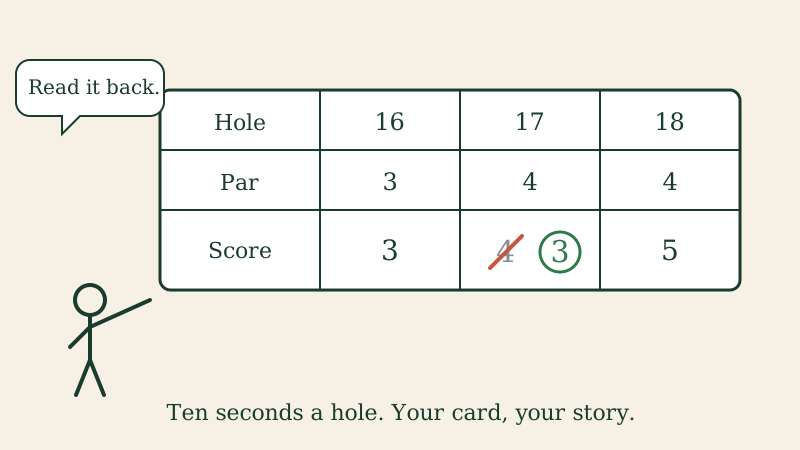
At the 1968 Masters, Roberto De Vicenzo made a birdie 3 on the 17th, but his card showed a 4. He signed it, so his 65 counted as a 66 and he missed a playoff by one. The beginner lesson: write your score at the next tee, count it out loud and read your card back at the end.
Even the greats: a birthday 65 at Augusta
Sunday, April 14, 1968, was Roberto De Vicenzo’s 45th birthday, and he played like it was a gift. The Argentine, the reigning Open champion, holed out from the fairway for eagle on the very first hole and kept making birdies. At the par-4 17th he hit his approach close and made a birdie 3, with fans on the course and viewers around the world watching.
A bogey on 18 stung, and he sat down at the scorer’s table shaken. His playing partner, Tommy Aaron, was keeping his card. In the excitement around the 17th green, Aaron had written down a 4 instead of a 3. Aaron slid the card over to be checked. De Vicenzo, still upset about the last hole and being called to the press room, signed it without looking closely.
Under the Rules of Golf, a player is responsible for each hole score on a signed card, and a higher score stands. So his 65 went into the books as a 66, one shot short of a playoff with Bob Goalby, who won by one. Both men played brilliant golf that day. Masters.com notes their combined 132 is the best final-round total for the top two finishers in Masters history. De Vicenzo is remembered as much for his grace as for the mistake.
Your first-nine lesson: ten seconds of scorecard calm
You almost certainly won’t be signing a card at a major. But this habit is worth having from your very first nine. Your scorecard is your story: the number you’ll look back on when you start seeing progress.
- Write your score at the next tee, not on the green. It keeps the group moving and gives you a calm moment to count.
- Count out loud once. “Tee shot, chip, two putts: four.” Simple and honest.
- If someone else keeps your card, read it back together at the end. Hole by hole, ten seconds each.
- Don’t fear a big number. An honest 8 tells you more than a guessed 6. It’s information, not a grade.
New to scorecards? Our how to keep score in golf guide keeps it to counting and writing one number per hole, and how to read a golf scorecard explains every box and line.
Watch or read the official account
Get the free intro
One email. A short PDF. Clear next steps.
Want the full path for free? Free Getting Started guides
Related guides
- How to keep score
- How to read a scorecard
- Golf scoring systems explained
- Golf rules for beginners
- More “even the greats” stories
- Start here
Sources
- Masters.com, “Masters Scorecards: A Pocket-Sized History”
- Masters.com, “1968: Goalby’s Superb Play Often Overlooked”
- The Augusta Chronicle, “1968: De Vicenzo signs for wrong score, Goalby wins Masters”
- LINKS Magazine, “Tommy Aaron: I Was There”
- The R&A, Players’ Rule Finder: wrong score for a hole on a returned scorecard
Facts are taken from the official and news sources above. Players are named with respect; no player photos or video are used on this page.