
Stories · Even the greats
McIlroy’s 2011 Masters: how to bounce back from a bad round
By The First 9 Team ·
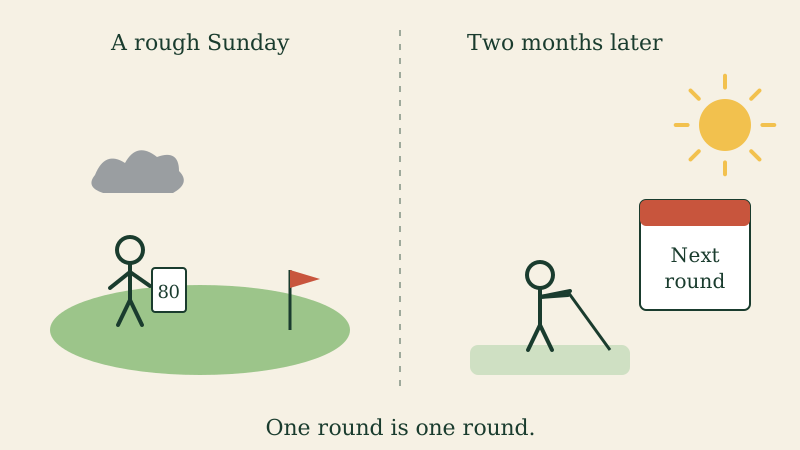
Rory McIlroy began the final round of the 2011 Masters with a four-shot lead, shot 80 and tied for 15th. Two months later he won the U.S. Open by eight shots. The beginner lesson: one rough round is just one round. Come back, keep it simple and play again.
Even the greats: Sunday at Augusta, 2011
Rory McIlroy was 21 years old when he started the last round of the 2011 Masters four shots clear of the field. He had led the tournament for 63 holes. Through nine holes on Sunday he was still in front.
Then the back nine got away from him. On the 10th, his tee shot hooked far left and settled between the cabins near the tee, an area TV viewers almost never see. A couple of shots later he walked off with a triple-bogey 7. He three-putted the 11th for a bogey, and four-putted the par-3 12th for a double bogey. He signed for an 80 and tied for 15th, while Charl Schwartzel birdied the last four holes to win.
What he said that evening is the part worth keeping. “I’ll get over it,” he told the BBC. “I’ll have plenty more chances, I know that.” He later added that this was his first experience of leading on a Sunday at a major, and that he hoped to handle it better next time.
He did. Two months later, at the 2011 U.S. Open at Congressional, he shot 268, 16 under par, a U.S. Open record, and won by eight. And in 2025, fourteen years after that Sunday, he won the Masters in a playoff to complete the career Grand Slam.
Your first-nine lesson: one round is one round
Every golfer has a day where the swing just leaves for a while. Maybe you hit it well on the range and then the first few holes feel like someone else’s game. That is normal, and it doesn’t mean you’re not built for golf. You have permission to treat a rough round as information, not a verdict:
- Let a bad hole end on the green. Write the number down, then walk to the next tee like it’s a new start.
- Shrink the goal when things wobble. Swap “par” for “get it on the green” or “two putts.” Small wins steady you.
- Lean on your simplest swing. A short, easy swing with your 52° or 56° is a fine way to get back to the short grass.
- Book the next round before the feeling sets in. The fastest way past a rough day is another, calmer one.
If your swing has gone strange, our my golf swing fell apart guide is a gentle place to start. Our simple weekly practice plan gives you an easy way back to the course.
Watch or read the official account
Get the free intro
One email. A short PDF. Clear next steps.
Want the full path for free? Free Getting Started guides
Related guides
- My golf swing fell apart
- Simple weekly practice plan
- Should I quit golf?
- Double bogey explained
- More “even the greats” stories
- Start here
Sources
- The Augusta Chronicle, 2011 final-round hole-by-hole scores for Rory McIlroy
- BBC Sport, “McIlroy positive despite Augusta collapse”
- BBC Sport, 2011 Masters day four live text
- The New York Times, “Charl Schwartzel Captures the Masters”
- RTÉ, “McIlroy: how the final round unfolded”
- Golf Monthly, “Rory McIlroy’s 2011 Masters final round nightmare”
- USGA, U.S. Open records
- Masters.com, “McIlroy, in a Playoff, Completes the Career Grand Slam” (2025)
Facts are taken from the official and news sources above. Players are named with respect; no player photos or video are used on this page.