
Stories · Even the greats
Doug Sanders 1970: why short putts deserve a routine
By The First 9 Team ·
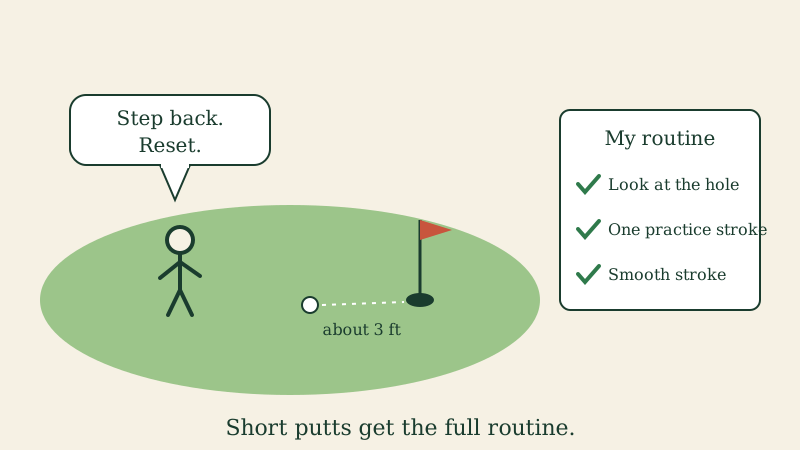
At the 1970 Open at St Andrews, Doug Sanders had about three feet for par to win. He bent down to pick something off his line, didn’t fully reset, and missed to the right. He lost the next day’s 18-hole playoff to Jack Nicklaus by one shot. The beginner lesson: short putts deserve the same calm routine as long ones, and stepping away is always allowed.
Even the greats: the 18th at St Andrews
Doug Sanders was one of the most popular players of the 1960s, a 20-time PGA Tour winner famous for his bright outfits. He had started out caddying at a nine-hole course in Georgia, practicing when nobody was watching.
In the final round of the 1970 Open, he played what Jack Nicklaus called the greatest bunker shot he’d seen in a major, out of the famous Road Hole bunker on the 17th, to save his par. That left him needing only a par 4 on the 18th to win.
His first putt came up short, leaving about three feet. As he stood over the ball he noticed something on his line and bent down to pick it up. By his own account he never really re-settled himself. He stood over the putt a long time and then jabbed at it, and it slid past on the right. “Why don’t you mark it?” he later remembered thinking. “You’re over it too long.”
The next day, in The Open’s first 18-hole playoff, Sanders played well and shot 72. Nicklaus beat him by one. Sanders carried the moment with humor for the rest of his life, joking that sometimes he went as long as five minutes without thinking about it. “That’s golf,” he said, “and that’s the fascination of the game.”
Your first-nine lesson: give the short ones the full routine
Short putts are where nerves sneak in, for everyone. They look easy, so we rush them, or we freeze over them. You have permission to slow down and do the same few things every time:
- Mark it if you need a moment. Picking up your ball and starting over is always fine.
- If something distracts you, step away. Back off, take a breath and begin your routine again. Nobody minds.
- Keep the routine short and the same. Look at the hole, one practice stroke, set up, go. Standing over the ball longer doesn’t help.
- Pick a small target. Aim at a blade of grass or the back of the cup, then make a smooth stroke.
- Miss one? It’s one shot. Tap in and enjoy the walk to the next tee.
Our putting basics for beginners guide covers a simple stroke and routine. If nerves are the real issue, our first-tee anxiety guide has calm-down steps that work on the green too.
Read the official account
Get the free intro
One email. A short PDF. Clear next steps.
Want the full path for free? Free Getting Started guides
Related guides
- Putting basics for beginners
- First-tee anxiety
- Double bogey explained
- How to keep score
- More “even the greats” stories
- Start here
Sources
- The Open, “99th Open, St Andrews 1970”
- The Open, “Stories of St Andrews: Doug Sanders and the best bunker shot you’ve never seen”
- The Open, “How Jack Nicklaus won The 1970 Open”
Facts are taken from the official and news sources above. Players are named with respect; no player photos or video are used on this page.