
Stories · Even the greats
Van de Velde 1999: why beginners should take the safe shot
By The First 9 Team ·
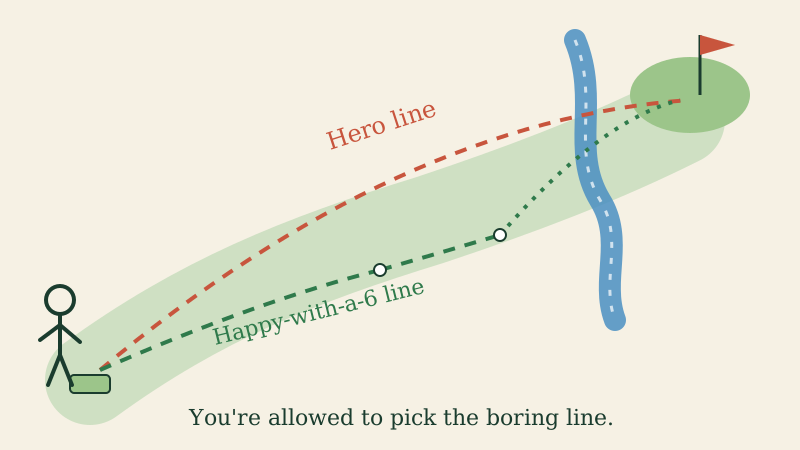
Jean Van de Velde needed only a double-bogey 6 on the final hole to win the 1999 Open at Carnoustie and made a 7 instead. The beginner lesson: decide the score you’d be happy with before you swing, then play the calm, boring shots that get you there.
Even the greats: the 18th at Carnoustie
In July 1999, Jean Van de Velde stood on the 72nd tee of The Open at Carnoustie with a three-shot lead. He had arrived that week ranked 152nd in the world. He had birdied the 18th hole in each of the two rounds before. Now a double-bogey 6 would make him only the second Frenchman to lift the Claret Jug.
What followed is one of the most replayed half-hours in golf. His drive went astray. His second shot struck a grandstand railing and bounced back into thick rough. From that heavy lie, his pitch found the Barry Burn, the creek that crosses in front of the green. He famously took off his shoes and socks and stepped into the water to consider playing it, then took a penalty drop instead. His next shot found a greenside bunker. Then he got up and down, holing a putt of about eight feet for a 7, a gutsy finish that kept him in a playoff.
Paul Lawrie, who had started the final round ten shots back, won the four-hole playoff over Van de Velde and Justin Leonard. Van de Velde met it all with remarkable grace. Years later he still talks openly about that hole, and golf fans remember him fondly.
Your first-nine lesson: the boring shot is allowed
Here is the part worth keeping. On that tee, the scorecard said you can make a 6 and still win. That is a generous number, and it can be a hard one to play toward when you are used to attacking.
You will have your own version. Maybe it’s a par 4 with water in front of the green, and you’d honestly be happy with a 6. You have permission to play for that 6:
- Pick the number you would be happy with before you swing. Then choose shots that get you there without the hazard in play.
- Lay up short of water. A short, easy swing with your 56° that stops in front of the creek is a perfectly good golf shot.
- From thick grass, just get it back to the short stuff. Sideways is fine. Nobody is grading style.
- If one does go in, take your drop and keep moving. It’s one hole on a nine-hole walk.
A double bogey isn’t a failure. Some days it’s the plan. Our double bogey guide explains why it’s simply a number, and golf hazards for beginners shows what to do around sand and water without stress.
Watch or read the official account
Get the free intro
One email. A short PDF. Clear next steps.
Want the full path for free? Free Getting Started guides
Related guides
- Double bogey explained
- Golf hazards for beginners
- Lost ball rules for beginners
- How to play a par-3 nine
- More “even the greats” stories
- Start here
Sources
- The Open, “128th Open, Carnoustie 1999”
- The Open, Jean Van de Velde player profile
- The Open, “The Story of 1999”
- NBC Sports, “Carnoustie ’99: An oral history of 18 and beyond”
Facts are taken from the official and news sources above. Players are named with respect; no player photos or video are used on this page.